Remembrance Sunday is a time to pause, reflect and remember the men and women who served during times of conflict and the many who never returned home. As thousands of people across the UK and Commonwealth prepare for the annual commemorative ceremonies on 8th November, the poppy remains a powerful symbol of remembrance.
© Public Domain
For those with an interest in motoring, historic WW2 military vehicles represent a story of engineering, ingenuity and the people who depended on them in extraordinary circumstances. From the muddy tracks of Europe to the deserts of North Africa, motorised transport played an important role in the war effort.
The vital role of military vehicles in WW2
Before the widespread mechanisation of armies, moving personnel, equipment and supplies over long distances could be slow and physically demanding, often involving horse-drawn transport. During the Second World War, motorcars and lorries became increasingly important to military operations, helping armed forces navigate difficult terrain and keeping essential supplies flowing.
The range of military vehicles in WWII was considerable, from small reconnaissance cars and motorcycles to ambulances and heavy transport lorries. Some carried officers between command posts, while others transported troops, ammunition, food and medical supplies. Ambulances brought wounded personnel to receive medical care in difficult and dangerous conditions. Every journey depended on drivers, mechanics, medics and support crews, who worked under immense pressure.
Allied and British army vehicles WW2
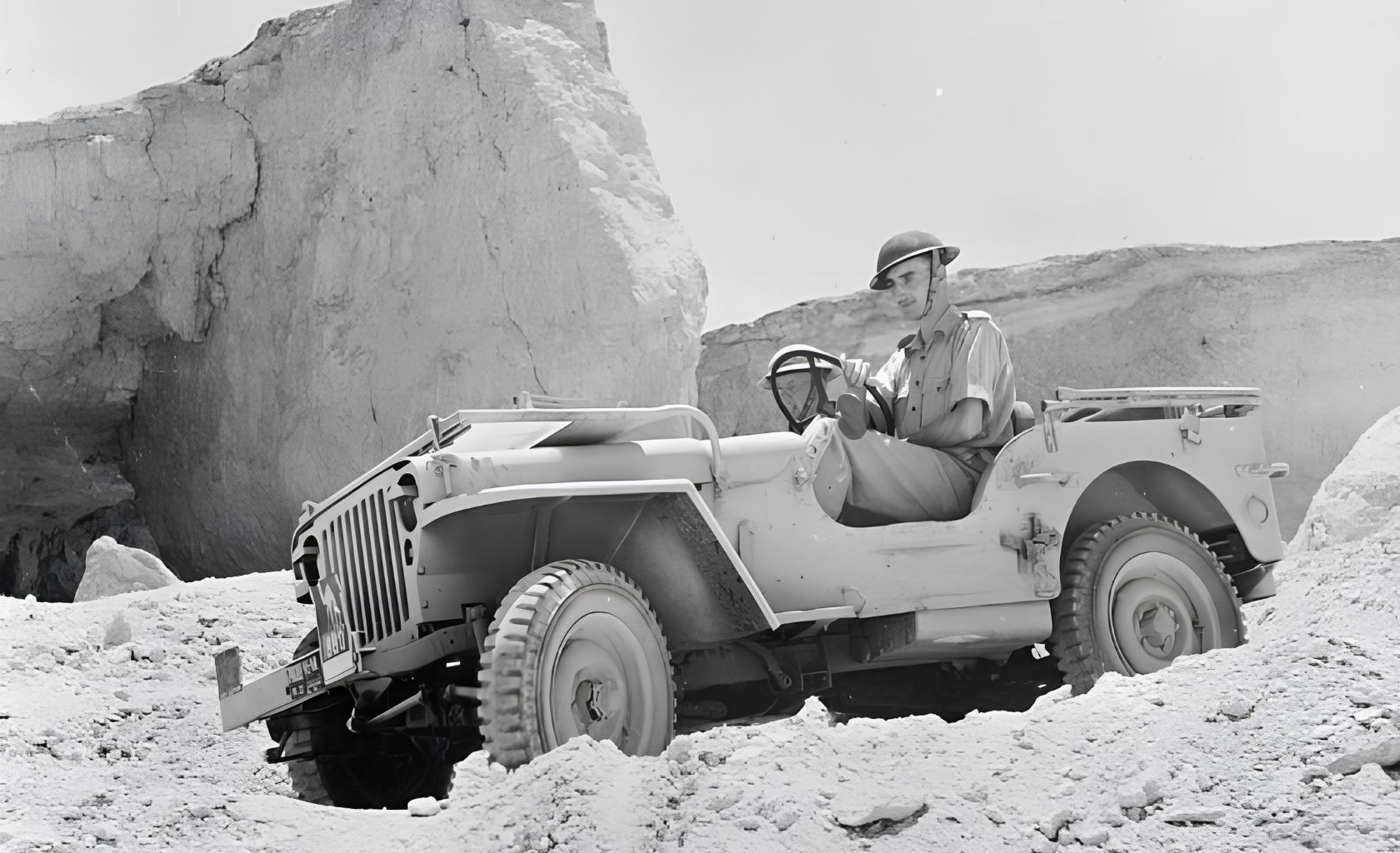
Among the most recognisable military transport of WWII was the American military Jeep. Developed to meet a US Army requirement for a lightweight, four-wheel drive vehicle, it became a familiar sight across Allied theatres of war.
As demand grew, Ford's manufacturing capacity helped meet the need for large numbers of vehicles. The Ford GPW shared many mechanical components with the Willys MB, making servicing and parts supply more manageable. Their versatility made them suitable for reconnaissance, liaison duties and transporting personnel. More than 600,000 Jeeps were built during the war and their influence on later four-wheel drive vehicles were considerable.
In Britain, Humber produced military cars and armoured vehicles, while Hillman supplied vehicles including the Tilly, a light utility car adapted for military work. Austin also manufactured military and utility models, while Bedford became particularly important for its range of trucks used to move personnel and supplies. The variety of vehicles reflected the different demands placed on the British and Allied forces.
The Jeep's post-war influence could be seen in the development of the Land Rover. The manufacturer recognised the potential for a practical, go-anywhere vehicle for civilian and agricultural use, drawing inspiration from the emerging market for compact utility vehicles, while developing its own distinctive design.
German military vehicles WW2
The evolution of Volkswagen in WW2 is inevitably linked to the development of practical military transport. The factory at Fallersleben, established in 1938 to produce the civilian KdF-Wagen, was soon manufacturing Volkswagen WWII vehicles for the armed forces and to advance the Axis efforts.
Among the best known, the VW Kübelwagen was officially designated the Type 82. Produced from 1940, it featured an air cooled, rear mounted engine and a lightweight body. Although it didn’t have four-wheel drive, its low weight and practical design made it useful on a variety of surfaces for personnel transport, communications and reconnaissance. It became one of the most recognisable German military vehicles of the conflict.
The Volkswagen Schwimmwagen, particularly the Type 166, was designed for use on land and in water. Featuring four-wheel drive and a deployable propeller for amphibious travel, its compact form made it suitable for operations where rivers and waterways presented obstacles. The Schwimmwagen remains a fascinating example of the WWII Volkswagen and how engineers responded to specific military demands.
For heavier transport, the Opel Blitz was a significant German three-tonne truck, carrying supplies and equipment across the military supply network. Opel's production was disrupted by Allied bombing in 1944, after which Daimler-Benz manufactured the truck at its Mannheim plant. This illustrates how wartime vehicle production could be reshaped by shortages, damage and the demand for standardised equipment.
How the war changed vehicle design
The demands of war meant manufacturers had to produce large quantities of vehicles under strict limits on materials, time and labour. They needed to be maintainable, dependable and adaptable, with parts that could be replaced without unnecessary delays.
Ground clearance, traction, load capacity and ease of repair all mattered. A vehicle might be expected to travel over rutted tracks one day and carry heavy equipment the next. In some circumstances, simplicity was a strength; fewer complications could mean easier repairs in the field.
Standardisation also became increasingly important. Where different vehicles shared components, mechanics could maintain them more efficiently and supply teams could manage spare parts effectively. These principles helped shape the development of utility vehicles after the war ended in 1945.
The Land Rover's military service
When the first Land Rover was launched at the Amsterdam Motor Show in April 1948, its practical design offered a new kind of utility vehicle for civilian and commercial use. The British Army ordered an initial trial batch in 1949, beginning a relationship that would continue for decades.
Over time, military Land Rover variants were adapted for increasingly specialised duties. The Series IIA Pink Panther, associated with the Special Air Service, was developed for long-range desert reconnaissance. Its distinctive pale pink finish was intended to provide camouflage in particular desert conditions.
Later generations included the Defender-based Snatch, developed with additional protection for service in Northern Ireland, and the Defender Wolf, a military vehicle designed to meet demanding service requirements. The Weapons Installation Kit, commonly known as WMIK or RWMIK, created a mobile platform for reconnaissance and support roles.
These vehicles became part of the landscape of British military service for generations of personnel. In 2025, the UK Ministry of Defence reported that more than 5,000 Land Rovers remained in service across the British military.
Remembering the people behind the machines
Preserving military vehicles helps keep an important part of history visible. On Remembrance Sunday, the sight of a restored Jeep, a wartime lorry or an old Land Rover can prompt memories and conversations for veterans and their families. They may be reminders of service, difficult journeys, friendships and lives shaped by extraordinary events.
The team at Autologics salutes all those who served. On 11th November, at 11am, we will be observing the 2-minute silence to remember our brave and gallant servicemen and women.